
Home / Insights / Waste transfer notes
Duty of care

What is a waste transfer note?

The legal record that follows your waste from your site to its destination. What it must contain, who signs it, how long to keep it, and what happens to it now digital waste tracking has arrived.

Updated July 2026 ยท 10 min read
The short answer

Waste transfer note, defined

A waste transfer note (WTN) is the legal document that records the transfer of non-hazardous waste from one party to another. It describes the waste, identifies who handed it over and who took it, and where it went.

It exists because of the duty of care under section 34 of the Environmental Protection Act 1990, which makes every business in the chain responsible for its waste until it is properly dealt with. Both parties must sign, and both must keep a copy for at least two years.

Hazardous waste is different. That needs a consignment note, and those must be kept for three years.

Why waste transfer notes exist

Under section 34 of the Environmental Protection Act 1990, anyone who produces, imports, carries, keeps, treats or disposes of controlled waste has a duty of care. That duty does not end when the skip leaves your gate. You remain responsible for making sure your waste is handled properly by the next person in the chain, and the one after that.

The waste transfer note is how you evidence that you took that duty seriously. It records what the waste was, who took it, and where it was going. If your waste ends up fly-tipped in a lay-by and you cannot produce a note showing you handed it to a registered carrier, the problem becomes yours.

Your duty of care follows the waste, not the skip. The transfer note is the only thing that proves you discharged it.

What a waste transfer note must contain

A note that is missing information is not a compliant note. These are the details that have to be on it.

The eight things every WTN needs

Get any of these wrong and the note may not stand up.

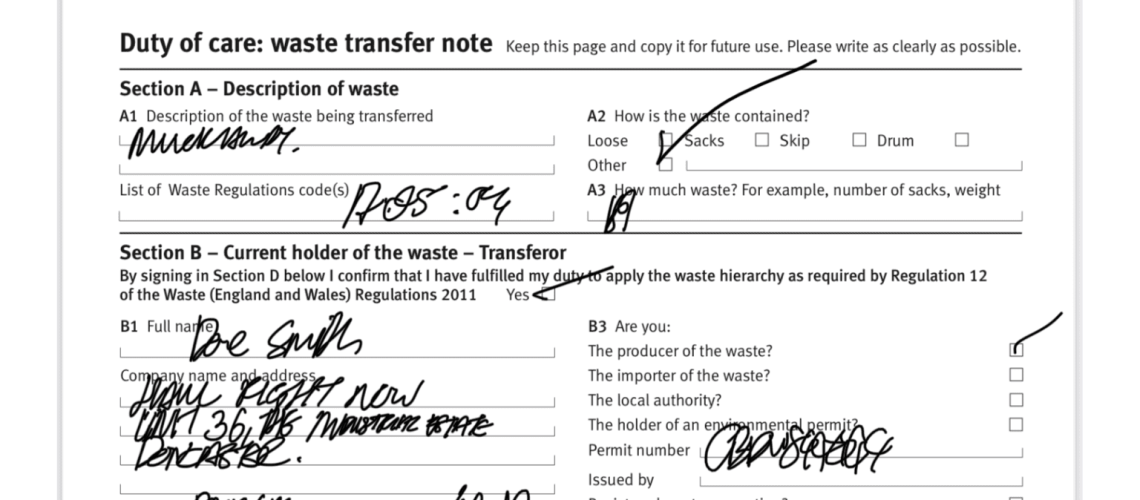
  1. A description of the wasteNot "general waste". Describe it properly: what it actually is, and its physical form, whether that's loose, solid, liquid, sludge or powder.
  2. The EWC codeThe six-digit European Waste Catalogue code that classifies the waste. This is the field people most often fudge, and it's the one regulators check.
  3. The quantityWeight or volume. Be specific.
  4. How it's containedSkip, bin, drum, loose in a tipper, bagged.
  5. Both parties' detailsFull name and address of the transferor and the transferee, and which of you is which: producer, carrier, broker, dealer, or holder.
  6. Carrier registration detailsThe waste carrier's registration number. If your carrier isn't registered, you have a much bigger problem than the paperwork.
  7. The transfer detailsDate, time and the address where the transfer took place.
  8. The SIC codeThe Standard Industrial Classification code for the business producing the waste. Frequently omitted, and it shouldn't be.

Both parties sign it. Both parties keep a copy. That last point catches people out: it is not enough for the carrier to hold the only copy.

How long you have to keep them

Retention periods differ depending on what the waste was, and the difference matters.

RecordKeep forApplies to
Waste transfer note At least 2 years Non-hazardous controlled waste
Hazardous waste consignment note At least 3 years Hazardous waste, or waste containing hazardous substances
Season ticket 2 years from the last transfer it covers Regular, identical transfers under one note

The season ticket, and why most people should use one

If you make the same transfer repeatedly, the same waste, the same parties, the same destination, you do not need a fresh note for every single collection. You can use a single note covering multiple transfers over a period of up to twelve months. This is commonly called a season ticket.

The catch is that "the same" has to mean the same. If the description of the waste changes, or a party changes, the season ticket no longer covers it and you need a new note. Site teams get this wrong regularly, treating a season ticket as a blanket that covers whatever leaves the gate.

Hazardous waste is a different document

If the waste is hazardous, or contains hazardous substances, a waste transfer note is not the right document. You need a hazardous waste consignment note, which requires more information and must be kept for three years rather than two.

On a construction site this comes up more often than people expect. Asbestos, contaminated soil, solvents, oils, batteries, fluorescent tubes, some paints and sealants. Getting the classification wrong is not an administrative slip, it is a compliance failure with the potential for prosecution.

Where people get it wrong

Common failures
  • ×Writing "general waste" in the description. It is not a description, it tells a regulator nothing, and it is the single most common defect on a note.
  • ×Guessing the EWC code. Picking a code that looks about right, or reusing the same one out of habit. Misclassification is what turns a paperwork issue into an enforcement issue.
  • ×Not checking the carrier is registered. You can check for free on the Environment Agency's public register. Almost nobody does.
  • ×Treating a season ticket as a catch-all. If the waste description changes, the season ticket does not cover it.
  • ×Only the carrier keeping a copy. Both parties must retain one. If your only copy is in someone else's cab, you have no evidence.
  • ×Illegible paper notes. A note nobody can read is functionally a note you do not have, and two years later nobody remembers what it said.

What digital waste tracking changes, and what it doesn't

This is the question everyone is asking, and the answer is being widely misreported.

DEFRA's digital waste tracking service is being introduced in phases: permitted waste receiving sites from October 2026, and carriers, brokers and dealers from October 2027. It creates a single national digital record of waste movements.

But it does not abolish the waste transfer note. The digital tracking regulations do not remove the existing requirement to complete and keep written descriptions of waste. For now, the two run in parallel. You will be doing both.

The point most people miss

If you were waiting for digital tracking to make your paperwork go away, it doesn't, not yet. What it does do is make paper a genuinely bad idea, because you now have to produce the same information twice. Recording a movement once, digitally, and having both records fall out of it is the only sensible answer.

For the detail on who is mandated and when, we've written a separate guide: will digital waste tracking affect my business? And if you're weighing up how to comply, here are your four options.

Should you go digital?

The honest answer is that the paperwork burden is about to go up, not down, and paper cannot cope with it.

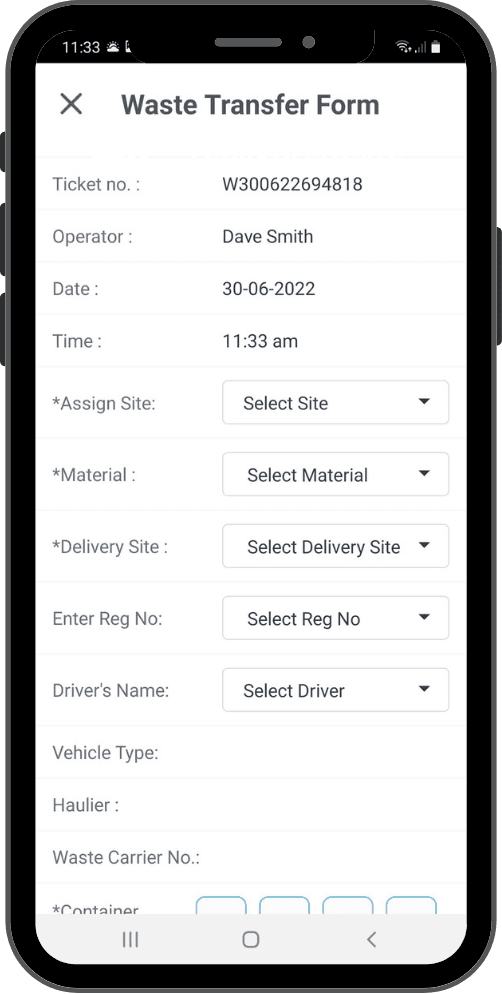
A digital waste transfer note removes the failure modes that make paper notes worthless: illegible handwriting, missing fields, notes that never make it back from the cab, and the impossibility of finding a specific note from eighteen months ago when a regulator asks. It also means the data you need for digital waste tracking already exists in a structured form, rather than being retyped from a damp carbon copy.

Sources: Environmental Protection Act 1990 (s.34 duty of care); GOV.UK guidance on business waste. Position as at July 2026. General information, not legal advice.

Digital waste transfer notes

Stop losing notes in the cab

Capture the transfer digitally at the point it happens, with every mandatory field enforced, both copies stored, and nothing to lose or misread two years later.

See digital WTNs Book a demo
FAQs

Waste transfer notes, answered

How long do I need to keep a waste transfer note?

At least two years for a standard waste transfer note. Hazardous waste consignment notes must be kept for at least three years. A season ticket should be kept for two years from the last transfer it covers.

Who is responsible for the waste transfer note?

Both parties. The person transferring the waste and the person receiving it must each complete, sign and keep a copy. Under the duty of care, responsibility does not sit with just one side of the transfer.

Do I need a waste transfer note for every collection?

Not necessarily. If you make the same transfer repeatedly, the same waste, the same parties, the same destination, you can use a single note covering multiple transfers over a period of up to twelve months. This is known as a season ticket. If any detail changes, you need a new note.

What is the difference between a waste transfer note and a consignment note?

A waste transfer note is for non-hazardous controlled waste. A consignment note is for hazardous waste, or waste containing hazardous substances. The consignment note requires more information and must be kept for three years rather than two.

What information must a waste transfer note contain?

A description of the waste, its EWC classification code, the quantity, how it is contained, the full details of both parties and their roles, the carrier's registration number, the date, time and place of transfer, and the SIC code of the business producing the waste.

Is a waste transfer note a legal requirement?

Yes. It is part of the duty of care under section 34 of the Environmental Protection Act 1990. Failing to keep proper records is an offence, and if your waste is mishandled and you cannot produce a note, the liability can fall on you.

Does digital waste tracking replace the waste transfer note?

Not yet. DEFRA's digital waste tracking regulations do not remove the existing requirement to complete and keep written descriptions of waste. For now the two run in parallel, so you will be recording both. More on digital waste tracking here.

Can I use a template for a waste transfer note?

Yes. A template helps make sure you capture every mandatory field, which is where most non-compliant notes fall down. The more durable answer is a digital note that enforces the required fields and stores itself, so nothing goes missing and nothing is illegible two years later.

How do I check my waste carrier is registered?

You can check for free on the Environment Agency's public register of waste carriers. It is a quick check that almost nobody does, and handing waste to an unregistered carrier is a breach of your duty of care.

Leave a Reply

Your email address will not be published. Required fields are marked *